Showing posts with label Bikes. Show all posts

Home Mechanic Toolbox

Saturday, July 19, 2014

If you are interested in building up your own bike, or would like to start doing your own maintenance and repairs, you have the exciting opportunity to get some new tools! But what tools do you need? What brand should you get? How much will it cost?

There are three main bicycle-specific tool manufacturers. They are Park Tool, Pedro’s, and Spin Doctor. There are others (Abbey, Avenir, IceToolz, Super B, Titan, etc.), but they aren't mentioned as often. Many will say that Park Tool is the gold standard, but those same individuals will admit that certain tools from other manufacturers are superior to those available from Park. For simplicity, and because most of my tools are Park, the prices and pictures represent Park Tools.


There are basically two methods to obtaining your tools. You can purchase a complete set, or buy the tools one-by-one. Typically, buying a set will be less expensive, but you will end up owning tools that you didn’t necessarily need (and perhaps missing some tools that you did). Once you know which tools you need, you can compare the cost of a complete set with purchasing them piece-by-piece.

Some of the tools you’ll need are specific to the bike and components you own (e.g. a bottom bracket tool). But many of the tools are universal (e.g. a chain break). I’ve listed the tools I have found useful and sorted them into four categories, irrelevantly utilizing the acronym CARB to define Cleaners, Adjusters, Replacers, and Builders.


The Cleaner


Item Price Description
Chain lube $ 8 Lubrication for the chain
Brush set $ 18 Brushes to scrub cassette, chainrings, chain, and derailleurs
Degreaser $ 18 Removes grease from cassette, chainrings, chain and derailleurs
Chain scrubber $ 24 Scrubs and degreases the chain
Total $ 68


Brush Set

Chain Scrubber


The Adjuster


Item Price Description
Spoke wrench $ 7 Replace or tighten spokes and true wheels
Anti-sieze compound $ 8 Reduce friction in threaded connections (e.g. pedals)
Grease $ 8 For moving connections (e.g. headset and bottom bracket)
Carbon paste $ 13 For tight carbon-to-carbon connections (e.g. seat post)
Pedal wrench $ 14 Tighten, remove, or replace pedals
5 N·m torque wrench $ 28 For 5 N·m torque requirements (e.g. stem and handlebars)
0-70 N·m torque wrench $ 45 For higher-torque requirements (e.g. pedals and crankset)
Total $ 123

Spoke Wrenches


Torque Wrench (5 N·m)

Torque Wrench (0-70 N·m)


The Replacer


Tool Price Description
Cassette lockring tool $ 8 Replace the cassette
Chain checker $ 10 Check to see if chain needs to be replaced
Chain whip $ 20 Holds the cogs while using the cassette lockring tool
Bottom bracket tool $ 21 Used to install a new bottom bracket
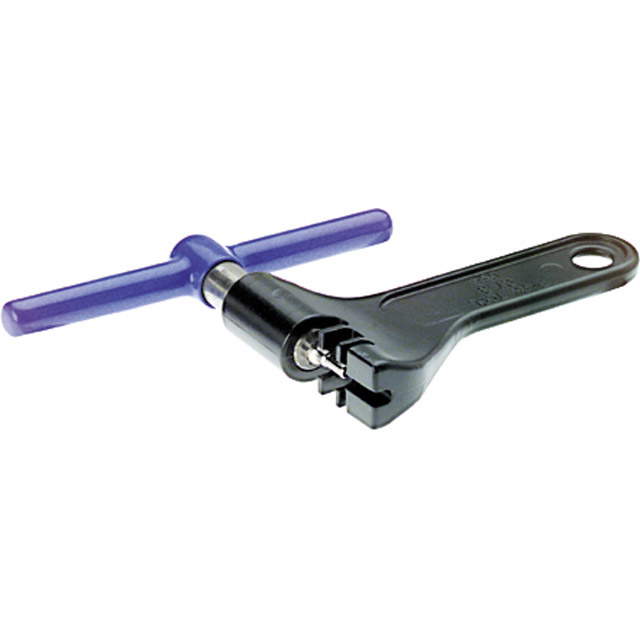
Chain tool $ 30 "Breaks" the chain so it can be replaced
Cable/housing cutter $ 33 Cut cables and cable housing for shifting and brakes
Stand $ 180 Holds the bike secure above the ground
Total $ 302


Cassette Lockring Tool

Chain Whip


Chain Checker

Chain Tool


Stand

Cable/housing Cutter


The Builder


Tool Price Description
Carbon saw blade $ 9 Cut the carbon steerer tube and carbon seat tube
Saw guide $ 35 Ensure straight steerer tube and seat tube cuts
Truing stand $ 99 Holds wheel and indicates out-of-true locations
Headset press $ 153 Install headset and bottom bracket
Total $ 296


Saw Guide

Truing Stand


Other

Some other tools and accessories you’ll need that you probably already own include electrical tape, hex wrenches, open-end wrenches, rags, scissors, screwdrivers, and zip ties. There are also some accessories that make life easier, like a handlebar holder ($18), work tray ($32), and cable stretcher ($40).


Cable Stretcher

Handlebar Holder

Did I forget anything? Let me know and I'll add it to the list.

New Bike Build: Part 1

Friday, November 8, 2013

Bike Build Part 1 Bike Build Part 2 Bike Build Part 3 Bike Build Part 4


There are many factors to consider when purchasing a bike. Manufacturer, material, type, size, color, components, wheels, etc. The first thing I decided was that I wanted to build my new bike up myself instead of purchasing one ready to ride. I won't be able to ride for at least another month, so I have the time to do it and I greatly enjoy figuring out how things go together. Plus, I'm looking forward to the satisfaction of riding something that I had a hand in creating.

The Frameset


Some decisions were made almost immediately. I knew I wanted to try a new manufacturer (previous bike was Specialized). I knew I wanted a carbon fiber frame (previous bike was aluminum).  I knew that I wanted a dark-colored bike (previous bike was white and a constant hassle to keep clean). And I knew I wanted a slightly smaller frame (previous bike was a 58cm). I enjoy climbing Mt. Lemmon, riding the Saturday Shootout, and sprinting for the finish in crits and road races, so a lightweight, aerodynamic, stiff frame would seem to be ideal.

With all the free time I had lying in bed for 2 months, I read dozens of articles looking at the different options available for the latest trend of road bikes: aero. I've heard (and read) a lot of praise for aero road bikes, and I like the idea of having a bike that I can use for (and hopefully obtain good results in) time trials -- without the need of a second, TT-specific bike. The aero road bikes I looked at were the BMC Timemachine, Cervelo S5, Felt AR, Fuji SST, Giant Propel, Ridley Noah, and Scott Foil (I ruled out the Specialized Venge on account of wanting to try a new manufacturer).

Some articles comparing different aero road bikes if you're interested:
Below are some of the options I looked at (with links to reviews of each bike):

BMC Timemachine
Cervelo S5
Felt AR
Fuji SST
Giant Propel
Ridley Noah
Scott Foil

I've always liked the look of the Ridley bikes and out of the aero lineup I definitely preferred the look of the Ridley over the others. The curved top tube, integrated seatmast, and overall "stance" are significantly more appealing to me. Of course this is subjective but there were other, more objective factors that came in to play like the split fork & seat stays, drag-reduction strips on leading edges, and integrated brakes. As an engineer, I think these features -- though admittedly borderline gimmicky -- are pretty cool and set the bike apart from the others. Ridley claims a 20 watt savings at 40kph (25mph) due to their aerodynamic features over a standard road bike. Doesn't seem like much at first but looking at the Shootout segment from Valencia to the bridge, I tend to average 24mph and 240 watts, which means riding the Noah would require just about 10% less energy.

Drag-reduction strip

The Noah comes in three versions: the RS, Pro, and FB (aka "Fast"). The RS is the least expensive, using a heavier carbon layup, and doesn't have the integrated seatmast. The Pro uses a better carbon layup and has the integrated seatmast, but doesn't have the integrated brakes. The FB is the most expensive and includes all the features. The price of the FB was high enough that it was thrown out as a possibility. The integrated seatmast results in better aerodynamics and a cleaner look but could potentially be a resale problem and you want to make sure you get it right when you cut it. The better carbon used in the Pro version, however, was enough to convince me to overlook the drawbacks of the integrated seatmast. Besides, I don't plan on selling this bike any time soon, and I've learned to measure 16 times and cut once. Ridley's sizing is small, medium, large, etc. and the size I was looking for was equivalent to a 56cm, which for Ridley is a medium.

Split fork

With my decision almost finalized I did some more online research specifically geared towards finding the flaws of the Noah. The main issues that I dug up were pretty minor. One was the cost and the other was the frame stiffness. For my build, cost isn't much of an issue because I am looking to buy a 2-year old (but still new) frameset, not a 2014 complete bike fresh off the assembly line. The stiffness issue for me also isn't a bad thing since I desire a stiff frame. In fact, one reviewer rode the Noah Pro on his first set of back-to-back centuries and "didn't feel beaten up afterwards."

Integreated Brakes

I felt very confident that the Ridley Noah Pro was the one to get, but during my final searches I came across a deal on a Noah FB that I couldn't ignore. It turned out that Ridley had just one medium-sized 2-year old Noah FB left in their stock and I had a chance to snag it at a smoking price. I jumped on it. A little over a week later and I'm now the proud owner of a Ridley Noah FB frameset in the team colors (black with red accents).

The latest addition to our family

If you are feeling lucky and wouldn't be opposed to acquiring a brand new, fully-customized 2014 Noah FB, you can enter a free contest at Ridley's website (contest ends February 3).
Click here to enter. Good luck!

In Part 2 I'll be discussing components and wheels. If you'd like to received e-mail updates when new posts are published, enter your e-mail address:

I'm looking forward to the build -- and very much looking forward to the first ride. If you have any questions or suggestions on the build please feel free to comment below.

Bike Build Part 1 Bike Build Part 2 Bike Build Part 3 Bike Build Part 4

Cons... and Pros

Friday, October 25, 2013

I'm told they all have one, you just have to look for it

With all the pain, frustration, and  difficulties that result from getting rear-ended by an SUV while riding your bicycle... there are at least a few benefits worth mentioning (not that I would recommend the "windshield-headbutt to asphalt-faceplant" as a means of acquiring them).

Benefit #1: Teenager Mode


With the majority of the pain (and corresponding pain medication intake) occurring during the night, the mornings end up being a foggy haze reminiscent of the ones too-often awarded to my friends and I during our college years. While a hangover is no fun, whether it results from that party you should have left 3 hours earlier than you did, or some unfortunately-necessary Oxycodone taken at 3am -- it does mean that my alarm clock has been set in the "off" position for a couple months now. It means that I wake up when I can, which sometimes isn't until after I'm already hungry for lunch. I get out of bed, shower (if the wifey is home to assist me), get dressed, and get to work when I'm able to -- completely independent of the location of the hands on the clock hanging on my wall. It seems funny to say, but for a while now and for at least a little longer: I'm back in my Teenager Mode... I get to sleep in.

Benefit #2: Beach Bum


Being part owner of a mechanical engineering firm comes with certain expectations. At project kick-off meetings with building owners, architects, contractors, and the occasional interior designer, it is -- and always has been -- a given that when a mathematical calculation needs to be performed, I will be there -- calculator or slide rule in hand -- ready to immediately provide the correct answer. I am expected to turn in 10-months worth of work in 7 weeks. I am to reduce my fee twice while increasing my scope thrice. And I am expected to wear a short sleeve dress shirt with tie, slightly wrinkled slacks, miss-matched argyle socks, and of course... my pocket protector. Err... I mean, "a" pocket protector.

With the fashion accessory, aka "core brace," that I am required to wear 23.75 hours a day (doctor's orders, reinforced by the wifey), I have needed to hang up the dress shirts and opt for the weekend/vacation t-shirts. Now my clients can learn which rock bands I like, where I like to travel for vacations, and what year I graduated from the U. Additionally, if I am unable to escape the foggy morning haze prior to the wifey leaving for work, I must resign to wearing flip flops on account of my inability to put on socks or tie my shoes. It's almost like I'm back on the beach of Isla Kuanidup off the Caribbean coast of Panama. Almost.

Benefit #3: Captain I.P. Freely


Due to my doctor-ordered requirement to avoid bending over at all while the vertebrate heal, our entire household (at least for the time being) is subscribing to the 24/7-seat-up policy, which I haven't enjoyed for a little over 5 years now. Granted this benefit is likely to be the first one to go because 50% of the household is less than happy with it. And let me be perfectly clear: I am happily married going on a little over 5 years and much prefer the beautiful wifey over saving the 2 seconds lifting a seat any day of the week -- so I'm completely willing to lose this benefit when it comes time. I'll just enjoy it while I can.

Benefit #4: Rebirth


And last but not least, with my rear wheel and frameset sufficiently disassembled into a dozen or so pieces (read: destroyed), I am supremely blessed with the task of obtaining a new bike.

When I started cycling I noticed that I was always "checking out" other people's bikes. Even when driving around town if I saw a cyclist I would look to see what they were riding. At group rides I sometimes have trouble remembering names, but can always remember their bikes. For a while Evan was "the racer with the Fuji," Jason was "that guy with the Roubaix who used to have the Allez," Cody was "the guy with the CAAD who is also into mountain biking," and so on.

I've found myself in the exciting position to start completely over with my road bike; now armed with the knowledge I've acquired over the past year from reading magazine reviews, online forums and articles, friend's opinions, and most importantly -- my own experiences.

It's almost as if I get to choose my new "name" -- almost like choosing a new identity.

So what about you? What are you currently riding? What do you like about your bike? What do you dislike? If you were buying a new bike, what would it be? Feel free to comment below, I definitely appreciate your thoughts.